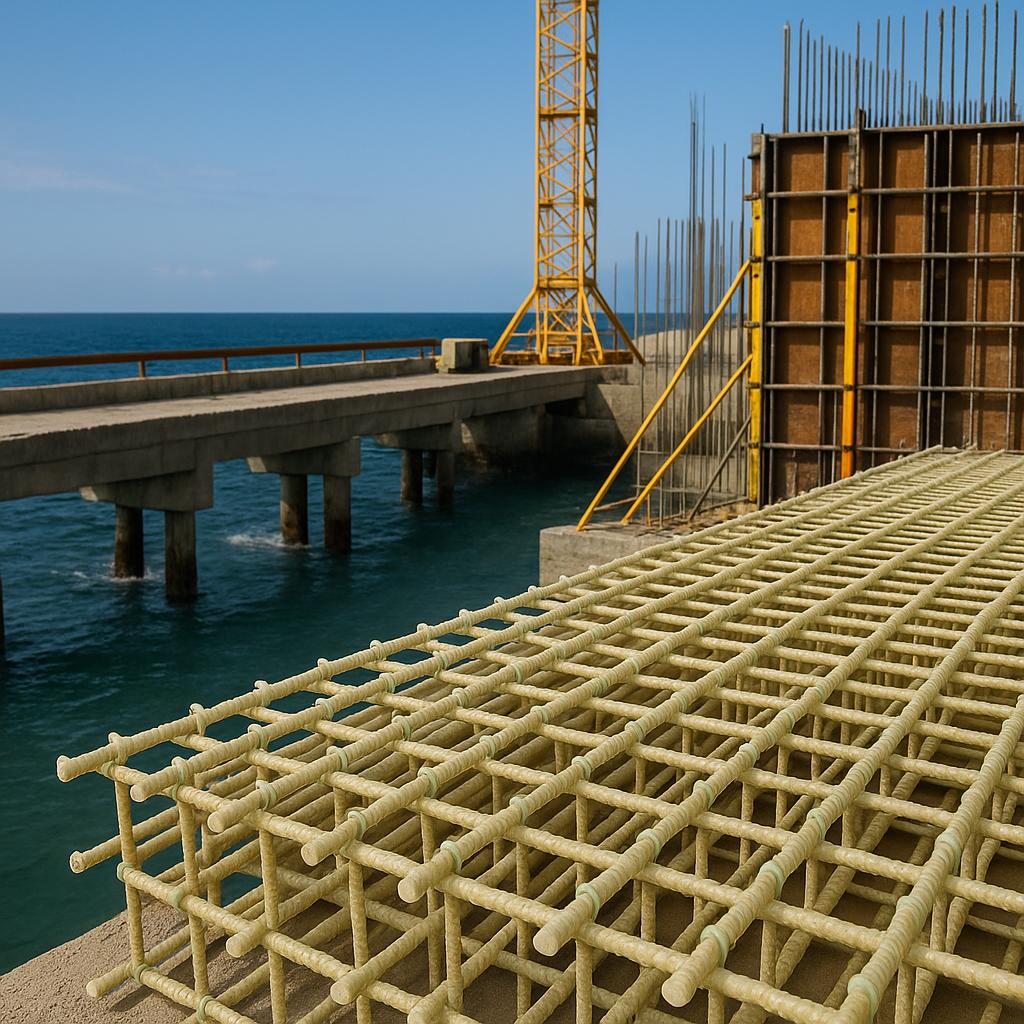
India's Port Infrastructure Crisis
Jetty decks, quay walls, pile caps in marine environments experience the most aggressive corrosion of any civil structure — 5–10x faster than inland.
Three Corrosion Zones in Marine Structures
Submerged Zone: Constant chloride saturation.
Tidal and Splash Zone (Most Destructive): Alternating wetting and drying. Steel corrodes at 0.1–0.3mm/year here.
Atmospheric Zone: Salt aerosols above splash zone.
GFRP Performance in Marine Environments
GFRP contains no iron — nothing to corrode. No measurable degradation in submerged specimens after 15+ years. No galvanic corrosion.
Applications in Port Structures
- Jetty decks — eliminates splash zone failure
- Pile caps — tidal zone corrosion immunity
- Fender panels — impact + corrosion resistance
- Approach road slabs — salt spray immunity
- Quay wall copings — highest exposure elements
Sagarmala Programme Case
India's ₹6 lakh crore port investment deserves 100-year materials. GFRP extends port structure service life from 30–40 years to 75–100 years with 25–35% lifecycle cost savings.
RN Elements supplies marine-grade GFRP rebar with IS 18256:2023 documentation for port procurement.