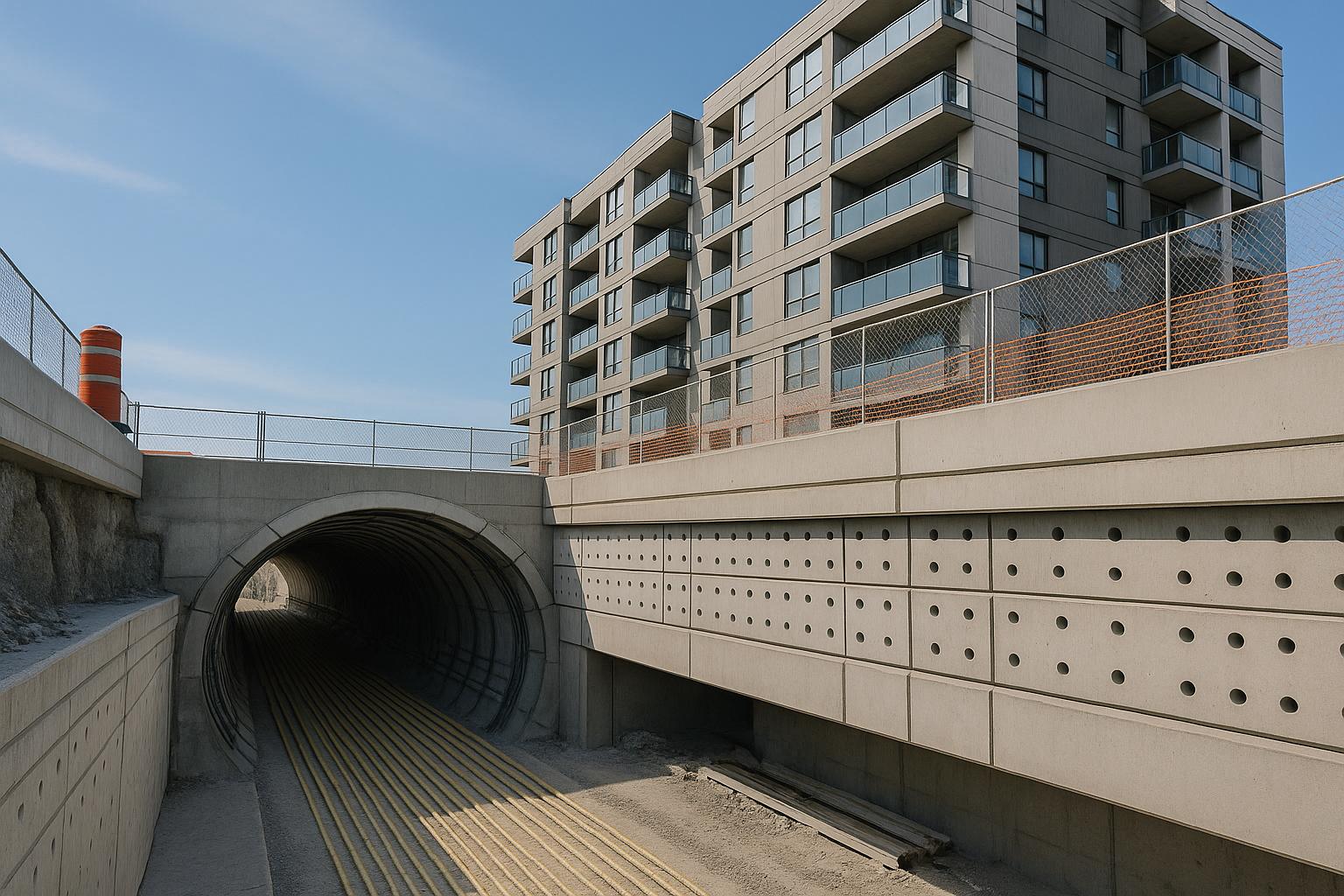
GFRP Rebar for Metro Rail Projects in India — The Non-Magnetic Advantage
India is in the middle of the largest metro rail expansion in its history. Delhi, Mumbai, Bangalore, Hyderabad, Chennai, Pune, Kochi, Ahmedabad, Surat — metro systems are being built, extended, or planned in cities across the country.
These are not ordinary construction projects. Metro rail infrastructure has requirements that go far beyond standard building codes — and one of the most critical is electromagnetic compatibility.
GFRP rebar is uniquely suited to meet this requirement. Here is why.
The Problem With Steel Rebar in Metro Infrastructure
Steel is magnetic and electrically conductive. In most construction, this is irrelevant. In metro rail systems, it creates serious technical problems.
Modern metro systems rely on:
- Track circuit signalling — detects train presence by measuring electrical continuity in the rail. Steel reinforcement near track level can interfere, causing false readings or signal failures.
- Axle counters and sensors — count wheel axles to track train positions. Magnetic fields from nearby steel reinforcement can disrupt sensor accuracy.
- Communication-Based Train Control (CBTC) — advanced automated train control using radio frequency communication. Steel mass near antennas and transponders affects signal quality.
- Traction power systems — stray currents from the electrified third rail or overhead catenary travel through conductive steel reinforcement, accelerating corrosion in nearby structures.
Stray current corrosion is a particularly serious issue. Traction currents leak into the ground and travel through any available conductive path — including steel rebar in nearby structures. This causes accelerated electrochemical corrosion that is difficult to detect and expensive to repair.
How GFRP Solves Both Problems
GFRP rebar is:
- 100% non-magnetic — no interference with track circuits, axle counters, CBTC systems, or any electromagnetic sensing equipment
- Non-conductive — no stray current paths through structural elements, eliminating stray current corrosion entirely
- Completely corrosion-free — regardless of moisture, groundwater chemistry, or stray electrical currents
This combination makes GFRP the engineering-correct choice for reinforced concrete in metro environments — particularly near tracks, traction power systems, or sensitive signalling equipment.
Where GFRP Is Used in Metro Rail Construction
| Metro Structure | GFRP Application |
|---|---|
| Platform slabs | Primary slab reinforcement near track level |
| Tunnel linings | Non-magnetic reinforcement for CBTC zones |
| Station floor slabs | Ground-floor and basement slabs |
| Retaining walls near tracks | Eliminates stray current corrosion |
| Underground station walls | Full structural reinforcement |
| Traction substation structures | Non-conductive reinforcement near electrical equipment |
| Depot floor slabs | Industrial floor reinforcement |
The Corrosion Argument — Even Stronger Underground
Metro tunnels and underground stations are permanently humid environments. Groundwater seepage, condensation from air conditioning systems, and general underground moisture create a corrosion-hostile environment for steel rebar.
Add stray traction currents and you have one of the most aggressive corrosion environments possible for steel-reinforced concrete.
GFRP rebar eliminates corrosion risk entirely. Metro structures reinforced with GFRP are designed to serve their full 100-year design life without corrosion-related maintenance — a meaningful operational and financial advantage for metro authorities.
Global Precedent
GFRP reinforcement in metro and rail infrastructure is not experimental. It has been specified in:
- London Underground extension projects
- Dubai Metro structures in corrosion-critical zones
- Multiple North American transit authority projects where electromagnetic compatibility is mandated
- Tunnel linings across European high-speed rail networks
India's metro expansion is the right moment to adopt the same standard.
RN Elements — Supplying Metro-Grade GFRP Rebar from Surat
RN Elements manufactures GFRP rebar in diameters from 4mm to 32mm at our Surat, Gujarat facility — with 100 tonnes monthly production capacity. We supply straight bars, coils, and pre-formed bent bars to project specifications.
For metro rail projects requiring non-magnetic, non-conductive, corrosion-free reinforcement — we are ready to support your technical and supply requirements.
Contact RN Elements for metro project enquiries →
📩 rnelementsllp@gmail.com | 📞 +91 9227990800
RN Elements — for creators who build a legacy.