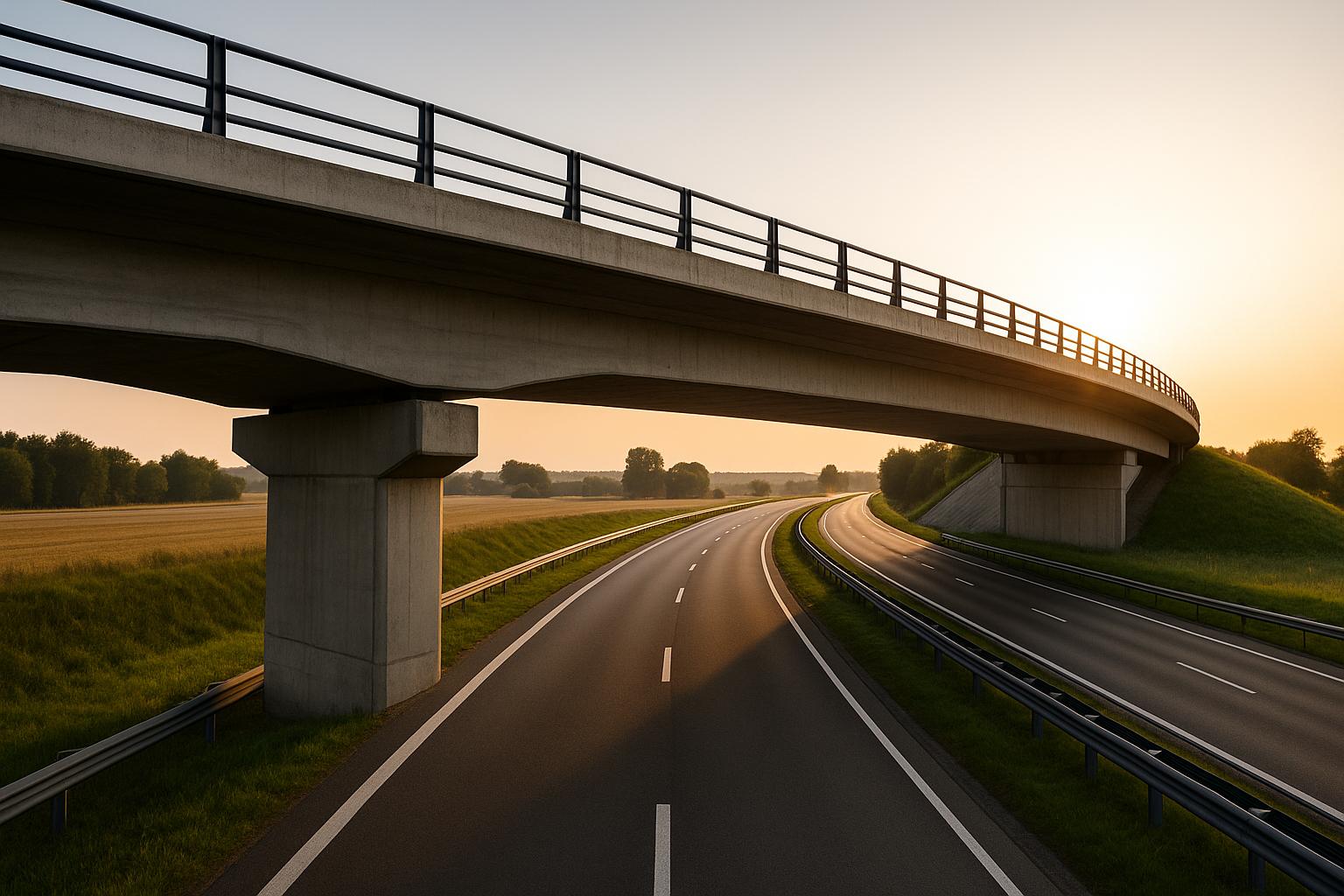
GFRP Rebar for Bridges and Flyovers — The Case for Corrosion-Free Infrastructure
India is building bridges and flyovers at an unprecedented pace. The infrastructure investment under national highway and urban development programs is in the trillions.
But here is a critical question that rarely gets asked: How long will these structures actually last?
The answer depends heavily on the rebar inside the concrete.
The Corrosion Problem in Bridge Infrastructure
Bridges are uniquely vulnerable to corrosion because they are exposed to:
- Rain and humidity — continuously
- Road salts and de-icing chemicals — on national highways
- Coastal air — for bridges near the sea or rivers
- Truck exhaust and pollution — in urban environments
- Water flow — for bridge piers and abutments in rivers
Steel corrodes under all these conditions. Once corrosion begins inside the concrete, it expands and cracks the cover — requiring expensive repair or, in severe cases, reconstruction.
India spends thousands of crores annually on bridge maintenance and repair. Most of that cost is driven by steel corrosion.
How GFRP Changes the Equation
GFRP rebar is chemically inert. It does not react with water, chlorides, carbonation, or road salts.
For bridges and flyovers, this means:
- No corrosion-related cracking of concrete cover
- No spalling of deck or girder surfaces
- No structural weakening over the design life
- Zero corrosion maintenance for 50–100 years
A bridge reinforced with GFRP is designed to serve its full life — not be repaired every 15–20 years.
Where GFRP is Used in Bridge Construction
| Bridge Component | GFRP Application |
|---|---|
| Bridge deck slab | Primary reinforcement |
| Approach slabs | Full GFRP reinforcement |
| Pier and pile caps | Corrosion-critical zone reinforcement |
| Retaining walls | Full replacement of steel |
| Crash barriers | Non-magnetic, lightweight reinforcement |
| River and coastal piers | Below-waterline reinforcement |
Global Adoption and Indian Standards
GFRP is already the standard specification for bridge decks in Canada (Ontario Ministry of Transportation), USA (FHWA), and Europe (Eurocomp).
India's IRC:112-2020 and BIS IS 18256:2023 now provide a formal framework for GFRP use in bridges and infrastructure.
Indian highway and urban development projects are increasingly specifying GFRP — and RN Elements is supplying to this growing demand.
Lifecycle Cost Comparison
| Steel Bridge | GFRP Bridge | |
|---|---|---|
| Initial construction | Standard | Comparable |
| 10-year inspection | Corrosion found, repairs begin | No corrosion |
| 20-year major repair | ₹₹₹ | Minimal |
| 50-year cost | Very high | Significantly lower |
| Design life | 30–40 years in harsh zones | 80–100 years |
The upfront investment in GFRP pays back many times over through avoided repair costs.
Conclusion
India's infrastructure deserves to last. GFRP rebar gives bridge and flyover structures the corrosion resistance needed to achieve their full design life — with dramatically lower maintenance burden.
For any infrastructure project where durability matters, GFRP rebar is the answer.
👉 Talk to RN Elements about bridge and infrastructure supply →
📩 rnelementsllp@gmail.com | 📞 +91 9227990800
RN Elements — for creators who build a legacy.